
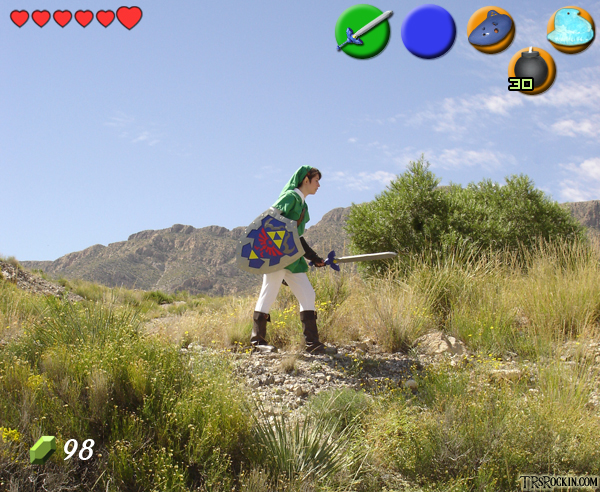
So, while casually chatting with Rob and Jerry on Monday, prior to recording the latest episode of the podcast, the topic of The Legend of Zelda: Ocarina of Time came up and, specifically, the fact that the game is largely regarded as one of the best games of all time. Reviewers at the time rated it as nearly perfect, with GameSpot, IGN, Famitsu, and a couple others going as far as giving the game a perfect score. Is the game truly worthy of that score?
This week I’ve been pretty bad off with the flu and laid up with congestion, aches, a very sore throat and bad cough, and my voice is basically gone, so as a result, I’ve had some time to think more about this subject. When the game made it to the U.S. back in 1998, I admit that I was pretty excited about it. I loved the earlier entries into the series (yes, even including Zelda II: The Adventure of Link), and up to that point, The Legend of Zelda: A Link to the Past was probably my favorite entry to date. I had read a lot about this new game from publications like the now-defunct Nintendo Power, and was excited to see how this franchise would make the leap into the 3D arena. When the game finally came out (right around my birthday, making it an awesome birthday gift!), I fired up my trusty Nintendo 64 and sat down, ready to be amazed by the latest installment in an awesome series.
One thing that I liked about A Link to the Past is that we were able to understand a bit about the origins of the series antagonist, Ganon. According to that game, Ganon was once a thief named Ganondorf who had sought out the Triforce within the Golden Land in order to obtain absolute power. Instead, the Triforce changed his very nature in order to reflect the evil within his heart and, in doing so, also altered the Golden Land. OoT was actually supposed to be set sometime before ALttP, so I was curious if they would come up with an altogether different telling of the story or expound on the one from the SNES game.
The Link of OoT is a ten-year-old boy who lives with the Kokiri (essentially, ageless child-like people) in their village at the edge of the Lost Woods, yet Link himself isn’t Kokiri. However, the Kokiri wear green tunics and hats as their standard style of dress, so this likely was meant to explain the origins of the hero’s clothing. It isn’t exactly clear how Link came to live with the Kokiri, but it is implied that something happened to his parents in the past, he was orphaned, and the Kokiri were nice enough to adopt him as one of their own. Link is told by the Great Deku Tree that a great evil is coming to Hyrule and that he should seek out the power of the Master Sword in order to put it to rest. Much like in ALttP, getting this sword requires him to collect three special gems to break the seal keeping it at bay.

The rest of the story of the game is something that by now you can easily search online to read about, but suffice to say that it takes the player on a journey across vast distances, including traversing the bounds of time itself. At the end of the journey, a mature, seventeen-year-old Link faces the evil Ganon in order to right the wrongs done to the people of Hyrule and then travel back to the past in order to warn the royal family of the impending crisis. Along the way, he meets new friends, powerful foes, explores dark dungeons, collects a vast array of neat items, and much more.
It’s pretty much what you’d expect from one of the 2D games, only in 3D!
The gameplay translated pretty well onto the N64. The controls make use of every button of the controller and, despite how many buttons a Nintendo 64 controller actually has, it works very well. Each of the C buttons can be bound to a special item – something akin to skillbinds in most of the major MMOs on the market today. This allows the player to swap between important items like the boomerang, healing potions, or the titular ocarina at the press of a button, thus reducing the need to interrupt gameplay to go to an item menu to swap things out. The “Z-Targeting” feature, however, is perhaps the best thing the game had to offer, because it allowed you to quickly swap between enemy targets and, once selected, pull out an item like the bow and take down an enemy without having to keep it constantly in your crosshairs.
Once you factor in then-cutting-edge graphics and a great soundtrack, you really do start to have a winner on your hands.

Now, though, I think it is time for me to point out some of the flaws that this game has – flaws that I felt were often overlooked because most reviewers were just enamored by the awesome aspects of Link’s then-new 3D outing.
First, I have always felt that the land of Hyrule in this game was fairly small and compressed. Yes, Hyrule Field and Lake Hylia both were pretty large and open areas, but beyond that, the subsequent areas are rather small. I admit that many games have an issue when it comes to scaling, but Hyrule is supposed to be a fairly vast kingdom – yet you can traverse it in a relatively short amount of time. This is further compounded by the fact that Hyrule Castle Town is much smaller than you would expect the capital of a kingdom to be (just a city square, really) and you can’t even go inside Hyrule Castle. This latter fact was one of the biggest disappointments in the game to me. You could freely explore the castle in the SNES game, but in this latest installment, you were relegated to looking through windows of a courtyard, and you couldn’t even see the king or anyone else other than random guards and the princess.
Next, as complex and interesting as the story of the game is, there are quite a few plotholes that we are left to ponder. First, it is never clear to us where Link comes from. Some sources say that his parents were killed sometime during a civil war that took place about a decade prior to the game, but others seem to disagree on this topic. Regardless, we know that he has been living with the Kokiri for some time by the onset of his adventure, but no real comments are made during the actual game regarding his true origins. Some argue that it may not even matter, although for the sake of accurate canon, I find it something I would have wanted answered. Then there is the fact that this game presents us with yet another origin story. Where ALttP talked about Ganondorf being that thief who sought the Triforce within the Golden Land, this game compounds that by describing him as the Gerudo King of Thieves who, yes, does seek the power of the Triforce. Yet, within the scope of the game itself, Ganon doesn’t seem to achieve this complete unification, as Wisdom and Courage are incorporated within Zelda and Link, respectively. Ultimately, Link defeats Ganon at the very end, seemingly killing him, and thus the events of this game cannot fully be thought of as what is described in ALttP.
Then there is the fact that this game creates multiple timelines from which different games evolve. In fact, ALttP and most other 2D games seem to stem from Link never defeating Ganondorf, allowing him to eventually seek out the Triforce in the Sacred Realm/Golden Land and his being sealed within that world by the Sages.
A lot of stuff was also removed from the game – more content than the supposed “URA” version (aka “Master Quest”) would have contained. There are screenshots on the internet that show 3D versions of the dungeons from the original Legend of Zelda, as well as Link approaching the gate of Hyrule Castle itself and talking to guards. While some of this was likely cut down for memory reasons, it would have been nice to see it added to the game.
I also would have liked to see a greater variety in locations as well as dungeons that were more…well…dungeon-y. It was neat to see places like the inside of the Jabu Jabu Fish, but I think better layouts, more truly intuitive puzzles, and a greater level of challenge would have been nice. As it was, you didn’t have to have anywhere near the full allotment of heart containers to be able to easily defeat Ganon at the conclusion of the game.
I think it is for this reason that I actually liked The Legend of Zelda: Majora’s Mask a bit more when it was released in October of 2000. The game was darker, a lot more challenging, and had (in my opinion) a more interesting story. Then again, I also happened to really like Zelda II: The Adventure of Link and even thought the CD-i games were okay, so…yeah.
When forced to rate the game, I cannot give it a perfect score, but I still think it holds up quite well even by today’s standards.
FINAL SCORE: 93% (A-)
———————————————————————————————————–
For other news, musings, podcasts, videos, and more, please check out Jessica’s gaming site Allahweh’s Domain!
 Nerdy But Flirty